From Conversation to Clinical Structure: How AI Bridges Real-Time Reasoning and Downstream Workflows
In our journey through the evolving landscape of clinical AI, we’ve explored how artificial intelligence is transforming the very essence of healthcare delivery. We began with Relievox AI’s foundational promise of marrying care with intelligence, then examined how it serves as the ultimate companion for busy clinicians. Most recently, we delved into how AI revolutionizes real-time clinical decision-making during patient encounters.
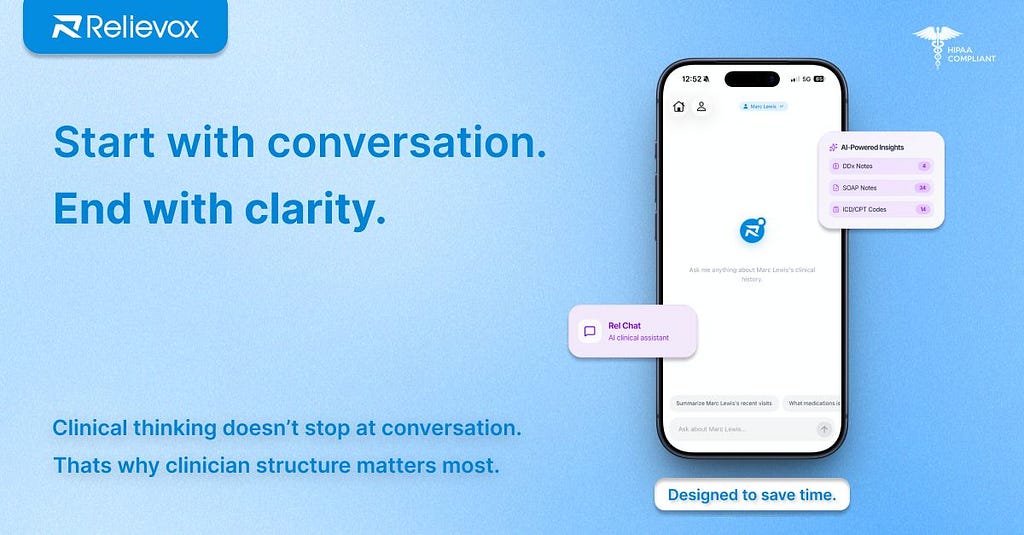
But here’s the critical insight that connects everything: Clinical thinking doesn’t end when the conversation does. That’s where structure matters most.
The most sophisticated clinical reasoning in the world means little if it doesn’t translate into the structured documentation, coding, and workflows that power modern healthcare operations. From quality metrics to prior authorizations, from risk adjustment to care coordination, healthcare runs on structured data. The challenge has always been bridging the gap between nuanced clinical conversations and the precise, coded information that downstream systems require.
This is where Relievox AI’s dual approach: combining Rel Chat’s real-time clinical reasoning support with AI-Powered Insights that transform conversations into structured clinical artifacts represents a fundamental shift in how we think about clinical documentation and workflow efficiency.
The Structure Problem in Healthcare
Every clinician knows the frustration: you’ve had a brilliant diagnostic conversation with a patient, made complex clinical connections, and developed a comprehensive care plan. Then you sit down to document it, and somehow the richness of your clinical thinking gets lost in checkbox interfaces, dropdown menus, and rigid documentation templates.
This disconnect creates cascading problems throughout the healthcare system:
Quality gaps: Rich clinical reasoning gets reduced to basic problem lists that don’t capture the full complexity of patient care
Coding inefficiencies: ICD-10 and CPT codes fail to reflect the true intensity and sophistication of clinical work
Workflow disruptions: Critical follow-up actions and care coordination details get buried in narrative notes
Revenue losses: Incomplete or inaccurate documentation leads to downcoding and missed reimbursement opportunities
Audit vulnerabilities: Disconnected documentation creates compliance risks and prior authorization delays
The traditional approach to solving this has been either ambient scribing (which generates better notes but doesn’t solve the structure problem) or rigid documentation templates (which capture structure but stifle clinical thinking). Neither addresses the fundamental challenge: how do you preserve the sophistication of real-time clinical reasoning while generating the structured outputs that healthcare operations demand?
Rel Chat: Reasoning in Real-Time
Relievox AI’s Rel Chat functionality represents a breakthrough in supporting live clinical reasoning. Unlike passive ambient systems that simply listen and transcribe, Rel Chat actively participates in the clinical thinking process during patient encounters.
Consider this scenario: Dr. Sarah Chen is seeing Maria Rodriguez, a 67-year-old patient with diabetes who’s reporting fatigue, frequent urination, and blurred vision. As they talk, Rel Chat doesn’t just capture the conversation but it helps Dr. Chen think through the clinical implications in real-time.
Patient: “The tiredness has been getting worse over the past month, and I’ve been getting up three or four times at night to use the bathroom.”
Rel Chat (appearing on Dr. Chen’s interface): Pattern recognition: Classic hyperglycemic symptoms in established diabetic. Consider: medication adherence, dosing adequacy, concurrent illness, dietary changes. Recommend: current HbA1c comparison, medication review, symptom timeline clarification.
This isn’t just transcription but it’s active clinical decision support that enhances Dr. Chen’s reasoning process without interrupting the patient relationship. As the conversation continues, Rel Chat builds a sophisticated understanding not just of what’s being said, but of the clinical logic underlying the encounter.
AI-Powered Insights: From Reasoning to Structure
Here’s where Relievox AI’s approach becomes truly transformative. After the encounter, AI-Powered Insights takes the rich clinical reasoning captured during the conversation and transforms it into the structured clinical artifacts that power downstream workflows.
Continuing with Dr. Chen’s case, here’s what happens after the patient visit:
Structured Problem List
Instead of generic entries, AI-Powered Insights generates precise, clinically relevant problem statements:
- Type 2 diabetes mellitus with hyperglycemia, inadequately controlled
- Diabetic retinopathy screening due
- Medication adherence assessment needed
- Nocturia secondary to hyperglycemia
Comprehensive Assessment & Plan
The system structures Dr. Chen’s clinical thinking into actionable components:
Assessment: 67-year-old female with T2DM presenting with classic hyperglycemic symptoms suggesting inadequate glycemic control. Symptoms consistent with osmotic diuresis and metabolic effects of persistent hyperglycemia.
Plan: HbA1c and basic metabolic panel today; medication adherence review; consider metformin dose optimization vs. additional agent; ophthalmology referral for retinal screening; patient education reinforcement.
Accurate Clinical Coding
AI-Powered Insights generates appropriate ICD-10 and CPT codes that reflect the true complexity of the encounter:
- E11.65 (Type 2 diabetes mellitus with hyperglycemia)
- Z79.4 (Long term current use of insulin)
- 99214 (Office visit, established patient, moderate complexity)
Workflow Integration
The system automatically generates structured outputs for downstream processes:
Orders: HbA1c, comprehensive metabolic panel
Referrals: Ophthalmology consultation with appropriate clinical context
Follow-up planning: 2-week appointment for medication adjustment based on lab results
Care coordination: Structured summary for diabetes educator and pharmacist consultation
Beyond Ambient Scribing: The Intelligence Difference
This integrated approach represents a fundamental departure from current AI documentation solutions. Most ambient scribing systems focus on generating better narrative notes. While this reduces some documentation burden, it doesn’t solve the structural challenges that create downstream workflow inefficiencies.
Relievox AI’s Clinical AI platform addresses three critical gaps that traditional solutions miss:
1. Clinical Context Preservation
Rather than simply transcribing conversations, the system preserves the clinical reasoning that drives decision-making. This means the structured outputs aren’t just accurate but they’re also clinically intelligent.
2. Smart Note Taking Evolution
The platform transforms note-taking from a post-visit burden into an integrated part of clinical thinking. Notes become byproducts of enhanced clinical reasoning rather than separate documentation tasks.
3. Patient First Structure
Every structured output prioritizes patient care continuity. Problem lists, care plans, and follow-up protocols are designed to support the next clinician who sees the patient, not just meet documentation requirements.
Building Trust Through Transparency
One concern many clinicians express about AI-generated clinical structure is trust: how can they be confident that the system’s interpretations accurately reflect their clinical thinking? Relievox AI addresses this through several key design principles:
Explainable Clinical Logic
AI-Powered Insights shows its reasoning process. When it suggests a particular ICD-10 code or structures an assessment in a specific way, clinicians can see the clinical logic that drove that decision.
Iterative Refinement
The system learns from clinician feedback. When Dr. Chen modifies a suggested problem list or adjusts a care plan, the AI incorporates that feedback to improve future recommendations.
Selective Automation
Rather than forcing wholesale acceptance of AI recommendations, the platform allows clinicians to accept, modify, or reject specific suggestions while maintaining workflow efficiency.
The Clinical Operation Efficiency Multiplier
The real power of this integrated approach becomes evident when you consider its impact on Clinical Operation Efficiency across the entire care continuum:
For Individual Clinicians: Reduced documentation time, improved coding accuracy, and enhanced clinical decision-making support during patient encounters.
For Care Teams: Structured handoffs, clear care coordination protocols, and consistent problem identification across providers.
For Health Systems: Improved quality metrics, reduced audit risk, enhanced revenue capture, and better population health management through consistent, structured data.
For Patients: More engaged providers during visits, clearer care plans, better care coordination, and improved continuity across the healthcare team.
Addressing Implementation Challenges
Healthcare organizations considering advanced AI documentation solutions often have legitimate concerns about workflow disruption and technology adoption. Relievox AI’s approach addresses these through:
Gradual Integration
Rather than requiring wholesale workflow changes, the platform integrates with existing EHR systems and clinical processes, allowing for gradual adoption and refinement.
Customizable Structure
Different specialties and organizations have varying documentation needs. The AI-Powered Insights functionality adapts to specialty-specific requirements and organizational preferences.
Training and Support
Comprehensive clinician training ensures that users understand both the capabilities and limitations of AI-assisted clinical reasoning and documentation.
Looking Forward: The Next Horizon
As we continue to explore the potential of clinical AI, several exciting developments are on the horizon. The foundation we’ve built combining real-time clinical reasoning support with intelligent structured documentation opens possibilities for even more sophisticated capabilities:
Longitudinal Clinical Intelligence: Imagine AI that doesn’t just optimize individual encounters but learns from patterns across multiple visits, helping clinicians identify subtle changes in patient status over time.
Multi-Provider Care Reasoning: Future developments may enable AI-assisted clinical reasoning that incorporates insights from entire care teams, supporting more coordinated and comprehensive patient care.
Predictive Workflow Optimization: By understanding both clinical reasoning patterns and downstream workflow requirements, AI could proactively suggest care pathways that optimize both clinical outcomes and operational efficiency.
Integration Ecosystem: The structured outputs generated by AI-Powered Insights could seamlessly integrate with population health platforms, quality improvement initiatives, and advanced analytics systems, creating a truly interconnected healthcare intelligence ecosystem.
Conclusion: Bridging Today’s Reality with Tomorrow’s Potential
The evolution from conversation to clinical structure represents more than just a technological advancement. It’s a fundamental reimagining of how clinical intelligence can enhance both patient care and healthcare operations. By supporting real-time clinical reasoning during patient encounters and then transforming that reasoning into the structured artifacts that power healthcare workflows, Relievox AI creates a bridge between the nuanced world of clinical thinking and the precise requirements of modern healthcare systems.
This isn’t about replacing clinical judgment. It’s about amplifying it, preserving it, and ensuring it flows seamlessly through all the systems and processes that support patient care. As we move forward in this series, we’ll continue exploring how these foundational capabilities enable even more sophisticated approaches to clinical intelligence and care delivery.
The conversation may end when the patient leaves the room, but with the right tools, clinical thinking can continue to power better care throughout the entire healthcare ecosystem. That’s the promise of truly intelligent clinical documentation and it’s a future that’s already beginning to transform healthcare today.